With more than 600 ship calls each year and a growing system for importing crude and exporting refined products, the Dangote Refinery has become one of the strongest drivers of maritime trade in Africa.
Many first-time visitors to the Dangote Refinery, which occupies about 2,635 hectares in the Lekki Free Zone in Lagos, often leave impressed by the scale of the project that billionaire Femi Otedola has described as the eighth wonder of the world.
The refinery now stands as a strong example of how private sector investment can close gaps that government-owned companies have struggled to address.
The $20 billion facility, according to Chief Executive Officer David Bird, was designed as a merchant refinery that depends heavily on maritime transport rather than the traditional model that relies on a single crude pipeline.
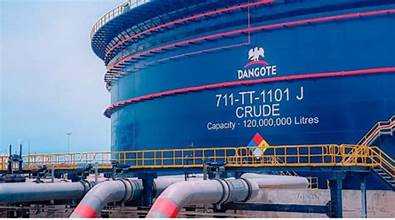
The refinery operates 177 storage tanks, and the company continues to expand them to support domestic distribution, product exports and the reception of raw materials.
To support its marine operations, the refinery built extensive berthing facilities that handle both imports and exports. Experts say this structure is gradually turning the company into a major maritime force in Nigeria.
During a recent tour of the facility, the head of marine, petroleum and petrochemical, Captain Satendra Singh Rana, spoke with maritime journalists at the landfall point where crude arrives and products depart. He explained the refinery’s offshore marine infrastructure in detail.
Rana said the refinery runs five single point mooring buoys offshore. Two serve crude oil while three handle refined products. Forty-eight-inch pipelines link them to the refinery and lie two metres beneath the seabed for safety.
He explained that the crude SPMs can receive the world’s largest tankers, including Very Large Crude Carriers that carry up to two million barrels. Some ships have delivered as much as three million barrels in a single cargo.
He added that the system allows quick turnaround times. Most vessels complete their operations within 24 hours while larger tankers finish within 36 hours. Since operations began in 2024, the terminal has handled about 800 tankers, which he described as a major achievement for a new refinery and terminal.
Rana said that once the refinery reaches its full processing capacity of 650,000 barrels per day, the facility expects around 600 tanker calls each year for crude imports and product exports combined.
He also noted that the offshore design uses natural water depths of up to 40 metres for crude operations and 20 metres for product shipments, which removes the need for expensive dredging.
He explained that a Houston-based company in the United States designed and manufactured the SPMs and telemetry systems. According to him, the equipment ranks among the safest used in global maritime energy trade. He also said the region’s relatively calm weather allows operations throughout the year.
The refinery’s marine facilities also handled the import of heavy machinery and equipment needed for construction. Bringing these large items through other Lagos ports would likely have caused serious logistical challenges.
The company used some of the most complex cargoes to test the strength and capability of the jetty.
The developers built a private greenfield wharf with breakwater protection and roll-on roll-off facilities to receive large refinery modules directly. This arrangement helped avoid congestion at Lagos ports and reduced the cost of transporting oversized equipment by road.
The first cargo arrived around late 2018, with an inaugural delivery recorded on November 13, 2018.
After that, the facility received many specialised vessels, including ten heavy-lift ships from BigLift and others that transported large equipment from different parts of the world.
Major refinery components also arrived through the port. These included crude distillation columns weighing about 2,350 tonnes, reactors of up to 1,500 tonnes and catalytic reforming units measuring about 86 metres long. Manufacturers shipped these structures from China, India and Italy.
Victor Ngangha Oyama, an engineer in the refinery’s Maintenance Planning Department, said the jetty has now evolved into a full import and export terminal that supports the refinery’s merchant model.
He said the port currently handles fertiliser exports to countries such as Brazil and receives raw materials for production. The company also plans to expand the facility further so it can receive more vessels as operations grow.
The refinery received its first crude cargo of one million barrels of Agbami crude supplied by Shell through the SPM system. This shipment formed part of an initial six-million-barrel supply provided by Shell, NNPC and ExxonMobil to start operations at 350,000 barrels per day.
Several additional cargoes of one million barrels each arrived between December 2023 and January 2024 to support the refinery’s startup operations.
The refinery began its first naphtha exports in May 2024 and also shipped jet fuel cargo to Rotterdam along with low-sulphur straight-run residues.
In October 2024, the refinery loaded its first seaborne gasoline cargo of about 500,000 barrels on the vessel MV Sabaek bound for Lagos ports. This shipment marked a shift from truck-only distribution to other transportation options.
By mid-2025 the refinery entered the global market with exports beyond West Africa. Within two months it shipped more than one million tonnes of premium motor spirit to Asia.
On August 26, 2025, the refinery sent its first gasoline cargo to the United States aboard the vessel MV Gemini Pearl carrying about 320,000 barrels that met US fuel standards.
This shipment marked a historic step for Nigeria because the country had previously exported only crude oil to the United States rather than refined petroleum products. More cargoes later followed the same route.
Earlier this year, the company reported that it had already recorded about 800 tanker calls since operations began. At full capacity of 650,000 barrels per day, the terminal expects roughly 600 vessel calls each year.
As part of its expansion plan, the refinery is considering the acquisition of vessels and plans to build four additional tanker jetties for LPG, gasoline, diesel and aviation fuel. It also intends to deepen the draft to 14.5 metres to accommodate vessels of up to 100,000 deadweight tonnes.
The refinery has helped reposition Nigeria as a maritime energy hub. Its operations generate revenue for the Nigerian Ports Authority through ship-related charges, create thousands of jobs in areas such as pilotage and towage and open new opportunities under the African Continental Free Trade Area for local vessel operators.
Industry observers say the refinery is becoming a major maritime asset for Nigeria. They point to its growing role in coastal shipping, fertiliser exports and regional trade integration.
They also praised the refinery’s maritime self-reliance and said it has the potential to generate one of the highest levels of maritime activity within a private sector industrial ecosystem in Africa.
During a recent visit to the refinery, Femi Otedola again described the project as the eighth wonder of the world.
He said the refinery represents an extraordinary achievement for Nigeria’s energy sector and predicted that a future expansion to 1.4 million barrels per day could strengthen the naira and support the country’s economy.
The Group Chief Executive Officer of NNPC Limited, Bashir Bayo Ojulari, also led a senior delegation to the refinery complex in Ibeju-Lekki as both organisations reaffirmed their commitment to deeper cooperation across Nigeria’s maritime and downstream energy sectors.
Ojulari described the refinery as a major development that will influence both the oil and maritime industries.
Maritime experts believe the refinery could reshape Nigeria’s maritime sector, create employment, support local participation and position the country as an important centre for regional and international shipping if authorities give greater attention to marine transport and Nigerian-owned vessels.
Captain Tajudeen Alao, National President of the Nigeria Association of Master Mariners, said the refinery is already emerging as a strong source of economic activity. He added that its location along the open sea provides Nigeria with a natural advantage for exports and maritime trade.
He explained that the deep-water access allows foreign vessels to berth easily and load products directly for international markets. He also noted that the facility could support coastal shipping services to ports such as Port Harcourt, Warri, Calabar and Lagos.
According to him, such coastal services would create jobs across the maritime sector, including vessel ownership, crewing, port operations and support services. He also urged policymakers to encourage the movement of petroleum products by sea instead of relying mainly on road transport.
He explained that Nigeria already has tank farms along its coastline. Ships could move products to these depots where they would be discharged and later distributed inland by trucks. He said marine transportation remains safer, more efficient and more economical.
Alao described the more than 600 vessel calls recorded within the refinery’s first year of operation as a significant opportunity for Nigerians to take part in maritime business. He also urged banks and financial institutions to support local operators with financing so they can acquire vessels.
He added that industry procedures such as tanker vetting, ship inspection reports and regulatory compliance also create opportunities for Nigerian mariners, surveyors and inspectors while improving certification and professional development.
To show the efficiency of marine transport, Alao noted that a 5,000-tonne tanker can carry the same load as about 150 trucks, each transporting around 30 tonnes. He said the tanker can complete loading within 12 to 18 hours, unlike trucks that often cause congestion and delays in port cities.
He also pointed out opportunities in maritime legal and professional services and said Nigerian lawyers and service providers should participate fully while ensuring compliance with international standards.
On vessel ownership and crewing, Alao said Nigerian regulations already support local participation. He explained that the law requires vessels operating locally to employ Nigerian crews and a majority of Nigerian officers, while cabotage rules also favour Nigerian involvement in domestic cargo transport.
source: independent.ng

 African Maritime Council