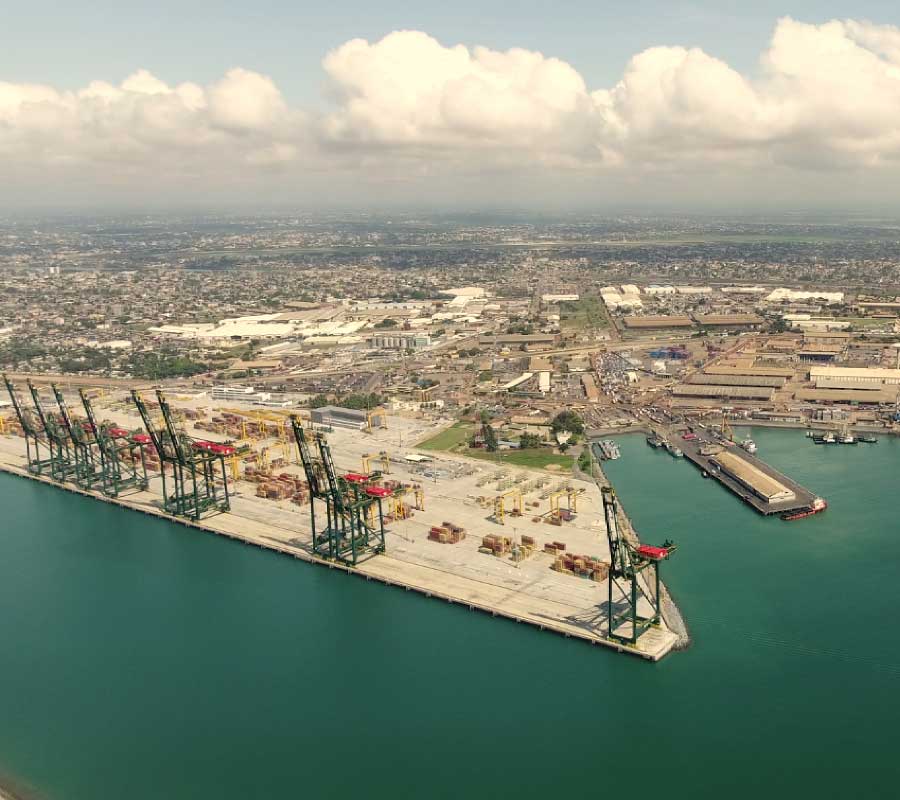
The Port of Lomé in Togo has entered a new phase of expansion as DEME’s trailing suction hopper dredger Breughel begins a dual programme of maintenance and capital dredging at the Lomé Container Terminal (LCT).
The project deepens the basin, turning circle, and access channel, directly improving navigability and preparing the terminal to handle the next generation of ultra-large container ships.
This dredging effort goes beyond regular upkeep. It signals Lomé’s determination to strengthen its role as West Africa’s top transshipment hub. Sitting on the Gulf of Guinea, the port connects landlocked countries such as Mali, Niger, and Burkina Faso, while also serving trade flows that extend into northern Nigeria.
LCT operates under a long-term concession managed by Thesar Maritime Ltd., with Mediterranean Shipping Company (MSC) and China Merchants Ports Holding as joint operators. MSC contributes through its terminal arm, Terminal Investment Limited (TIL), which co-funds infrastructure upgrades with China Merchants.
After MSC’s full takeover of Bolloré Africa Logistics, the company assumed control of both terminals in Lomé. This consolidation makes MSC the sole operator, raising new concerns about competition and access to the port.
The port’s performance remains strong. In 2024, Lomé handled 30.64 million tonnes of cargo, up 1.85% from the previous year. Container throughput reached a record 2 million TEUs, a 5.19% increase that positioned Lomé among Africa’s top five container ports. Transshipment volumes rose by 7.11%; imports edged up, while exports fell nearly 20%, reflecting shifts in regional trade flows.
LCT continues to deliver high productivity, averaging 32.5 crane moves per hour, a figure that surpasses most African and global standards. Investments in new gantry cranes and dredging form part of a broader €500 million plan to lift annual terminal capacity to 2.7 million TEUs.
The current dredging campaign, managed by DEME with support from Eiffage Génie Civil Marine, plays a pivotal role. It allows the port to berth ships over 19,000 TEUs and 400 metres long, a capability few African ports can match. The works proceed without interrupting operations, demonstrating Lomé’s operational efficiency.
These upgrades highlight Lomé’s intent to stay ahead as regional port competition intensifies. With Tema, Abidjan, and Lagos all boosting capacity, Lomé relies on its deepwater access, efficient customs systems, and strong transshipment performance to maintain an edge.
source: africaports.co.za

 African Maritime Council