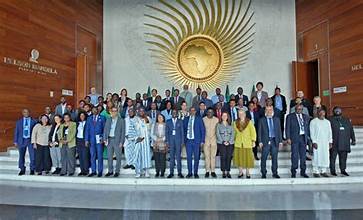
The 2nd edition of the Africa Blue Economy Week (ABEW) took place from 23 to 25 September 2025 at the African Union (AU) Headquarters in Addis Ababa, Ethiopia. Co-organized by the African Union Commission (AUC) and the United Nations Development Programme (UNDP), the gathering brought together more than 70 participants. Delegates included representatives from African Union Member States, Regional Economic Communities, intergovernmental organizations, civil society, research institutions, the private sector, UN agencies, AU specialized units, and bilateral partners.
Held under the theme “From Pledges to Stronger Partnerships”, the event served as a platform to accelerate the development, sustainability, inclusivity, prosperity, and resilience of Africa’s Blue Economy. It built on the Decade of African Seas and Oceans (2015–2025) and advanced the outcomes of the inaugural edition in 2024.
Discussions focused heavily on the need for effective policy harmonization and coordination. Participants stressed the importance of aligning national and regional strategies with the Africa Blue Economy Strategy. They emphasized mainstreaming national strategies, complementing frameworks with clear action and resource mobilization plans, and strengthening cross-sectoral governance. Calls were made to enhance institutional capacity and invest in awareness raising and knowledge sharing.
Delegates also welcomed the Africa Blue Economy Data Dashboard, recognizing it as a crucial tool for evidence-based decision-making. They recommended piloting the tool, linking it with existing data systems, and avoiding duplication.
Financing the blue economy emerged as a priority, with participants urging stronger support for sustainable private sector investment. They called for enabling environments that encourage innovative public–private partnerships, de-risking mechanisms, and proper valuation of Africa’s blue capital. Research institutions and development partners were encouraged to provide technical support in resource valuation and the development of viable project pipelines.
The private sector’s role was highlighted as central to transforming Africa’s Blue Economy. The African Continental Free Trade Area was seen as a driver of inter-regional trade and market expansion. Delegates stressed the importance of including women, youth, local communities, and the informal economy, while shifting from grant-dependency to asset creation and visibility of investable opportunities.
Strategic communication was recognized as a catalyst for transformation. Participants highlighted the need to raise awareness about the value of ocean and aquatic resources, showcase Africa’s leadership in innovation, and link small enterprises and communities to regional and global markets. Building trust among investors through visibility and communication was emphasized as essential.
To strengthen partnerships, participants proposed regional multi-stakeholder mechanisms aimed at bridging data gaps, mobilizing financing, and harmonizing policies and regulations. These mechanisms, they agreed, could boost collective action, generate political will, and drive trade and economic activity across the continent.
Delegates also celebrated Africa’s role in global ocean governance. They welcomed the entry into force of the High Seas Treaty following ratifications by Morocco and Sierra Leone on 19 September 2025, reaffirming Africa’s role in shaping the future of ocean protection. They urged faster ratification of the treaty across the continent and called for renewed awareness of the Lomé Charter to accelerate its adoption.
The week concluded with a strong reaffirmation of partnerships and collective action as the driving force behind Africa’s Blue Renaissance. Participants underscored the need for coordinated approaches to data sharing, policy harmonization, sustainable resource management, private sector engagement, innovative finance, and regional cooperation.
Looking ahead, participants recommended that the 3rd edition of ABEW in 2026 should combine both a technical meeting and a high-level ministerial conference. This dual structure would consolidate technical progress, strengthen political leadership, and help communicate Africa’s vision for its Blue Economy to a global audience.
source:maritimafrica.com

 African Maritime Council