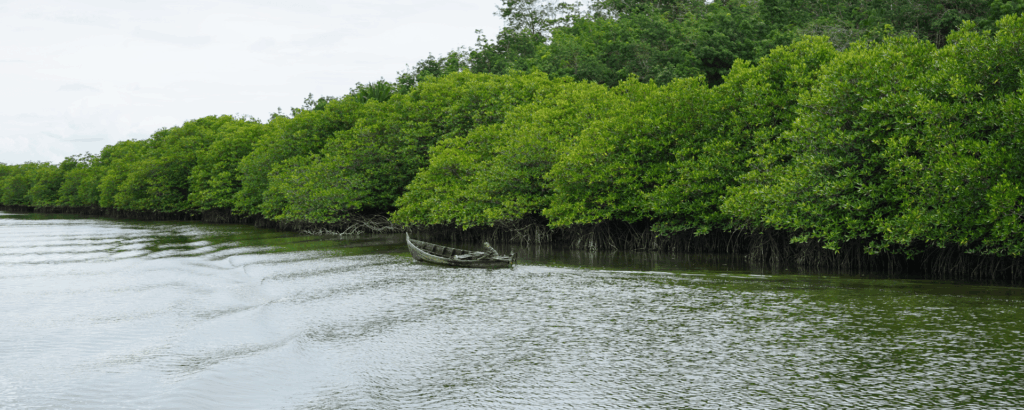
Guinea has started its first pilot blue carbon project in a mangrove ecosystem, marking an important development for its blue economy and coastal management. In Kakossa, Forécariah Prefecture, the Secretary General of the Ministry of Environment and Sustainable Development, Dr Karim Samoura, led an evaluation mission to assess the project being implemented with WEST AFRICA BLUE.
The project operates in the Amaraya district, where restoration activities have recorded more than 90% technical success in the field. The results show that mangrove restoration can support carbon storage while helping Guinea protect important coastal ecosystems. Mangroves also support fisheries and provide natural protection for coastal communities and shorelines.
The project plans to restore 7,000 hectares of mangroves, allowing the restored ecosystems to capture and store carbon while creating carbon credits under the Verra standard. Guinea’s environmental authorities are overseeing the process, including the environmental and social assessment required for the project. In 2025, the government reviewed and validated the terms of reference for the environmental and social impact assessment of the Forécariah carbon project.
The project also links mangrove restoration with coastal livelihoods. Revenue from carbon credits could provide another source of funding for the protection and restoration of Guinea’s coastal ecosystems while supporting income-generating activities for communities living around the mangroves. The government estimates that mangrove restoration projects across Guinea could mobilise between US$50 million and US$100 million, with revenues shared among the state, project operators and local communities.
The Forécariah project forms part of a wider mangrove programme being developed by WEST AFRICA BLUE in Guinea. The company’s broader project covers areas in Forécariah and Boffa and is expected to cover about 34,000 hectares through a combination of mangrove restoration and conservation. The project is being developed with the Guinean government and local communities and is progressing through Verra’s certification process.
For Guinea’s maritime and coastal sector, the project puts mangrove protection alongside carbon finance, fisheries, coastal resilience and community livelihoods. It also shows how coastal ecosystems can contribute to the country’s blue economy while creating a potential source of funding for long-term mangrove conservation.
source: WBA
